Will AI shut shop for recruitment agencies?
Every few months, someone predicts that Artificial Intelligence will make recruitment agencies irrelevant. After all, AI can search thousands of profiles in seconds, identify keywords, rank candidates, draft messages, analyse resumes and even conduct preliminary assessments.
Will AI shut shop for recruitment agencies?
Every few months, someone predicts that Artificial Intelligence will make recruitment agencies irrelevant. After all, AI can search thousands of profiles in seconds, identify keywords, rank candidates, draft messages, analyse resumes and even conduct preliminary assessments.
So, will AI shut shop for recruitment agencies?
Not quite.
AI can make a recruiter faster. It cannot automatically make a recruiter wiser.
Recruitment is often presented as a simple matching exercise: job description on one side, candidate CV on the other. But real hiring rarely works that neatly. The strongest candidate on paper may not be the right candidate for the organisation, the hiring manager, the culture—or the timing.
Consider a manufacturing company looking for a Plant Head. An AI system may identify candidates who have the right designation, years of experience, industry keywords and qualifications. But who determines whether that person has actually led a difficult shop floor, handled an aggressive production target, built credibility with workers, managed a demanding promoter and still kept quality and safety under control?
That requires nuance.
A good recruiter asks questions that may never appear in a CV. Why is the candidate really considering a move? Is the stated salary expectation genuine? Would the candidate relocate? Is the candidate leaving because of career ambition—or because of a problem with the current management? Will the candidate actually fit into the organisation's working style?
And then comes the most human part: persuasion.
Good recruiters sell opportunities to candidates and candidates to clients. They manage expectations, uncover concerns, negotiate compensation, handle counteroffers and sometimes persuade two people—who may initially be unsure about each other—that they should take a chance.
There is also something AI cannot easily quantify: instinct developed through years of conversations. An experienced recruiter can hear hesitation in a candidate's voice, recognise when a salary demand is negotiable, sense whether a candidate is genuinely interested and understand when a client's stated requirement is not the real requirement.
AI can provide data. It can improve sourcing, reduce administrative work and help recruiters make better decisions.
But hiring is ultimately a decision between people.
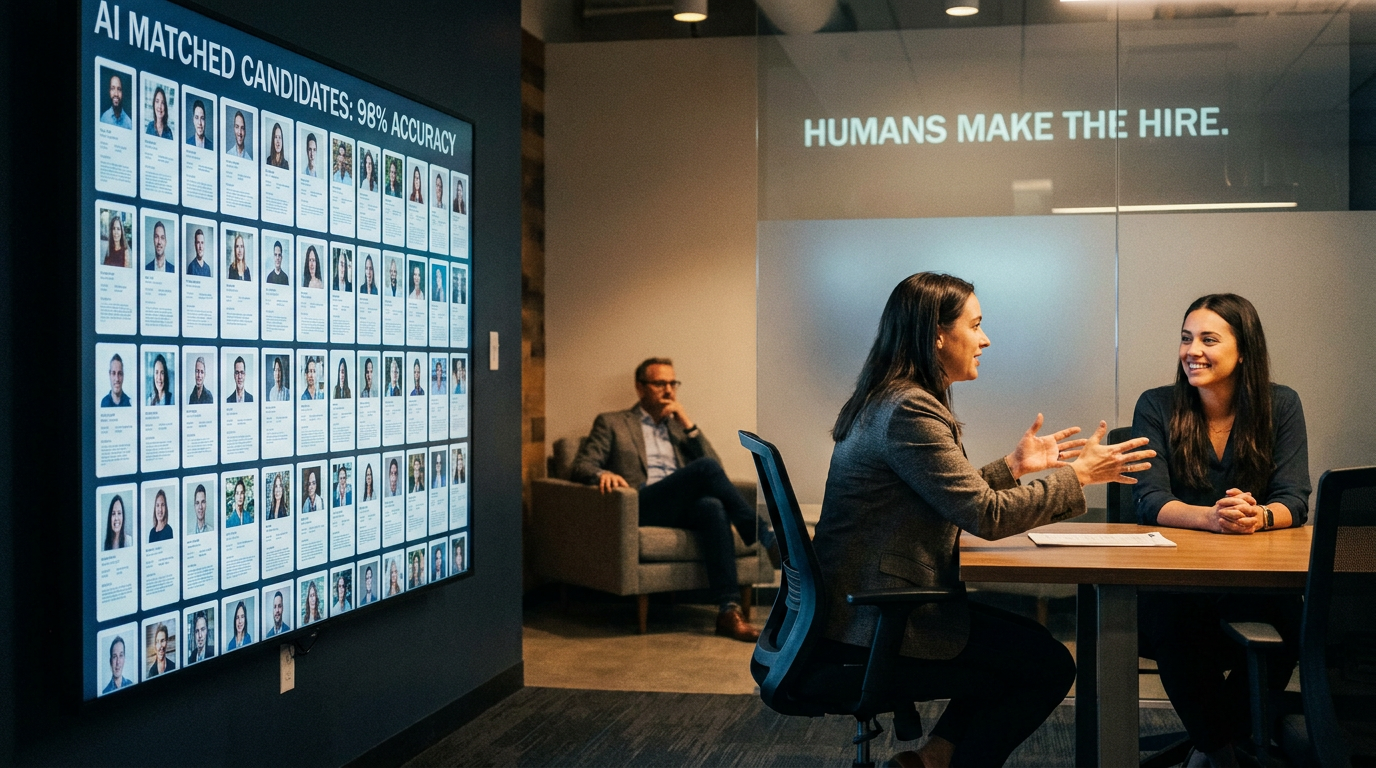
The future is unlikely to be AI versus recruitment agencies. It will be recruiters who use AI versus recruiters who don't.
AI may transform recruitment dramatically. But the recruiter who understands people, business and context will remain difficult to replace.
AI can find candidates. Human intelligence gets them hired.